

When you search for an “industrial pressure cooker,” you’ll find that prices vary widely — from modest mid-range units to high-end heavy-duty cookers. The variation can be confusing if you don’t know what drives the price differences. In this article, we break down the main cost factors and help you decide which model is worth buying depending on your needs.
1. What Is an Industrial Pressure Cooker & Who Needs One
An industrial pressure cooker is a heavy-duty cooking vessel designed for large-scale food production — suitable for factories, large kitchens, canning plants, centralized kitchens or any operation that needs to process large volumes of food quickly and consistently. Compared with household pressure cookers, these are built with stronger materials, larger capacity, more robust sealing and safety systems, and often offer electric heating or steam-based operation.
You might need one if you run:
Food processing factories (sauces, canned foods, stews)
Central kitchens for restaurants or catering
Large-volume canning or preservation lines
Commercial kitchens with high daily output
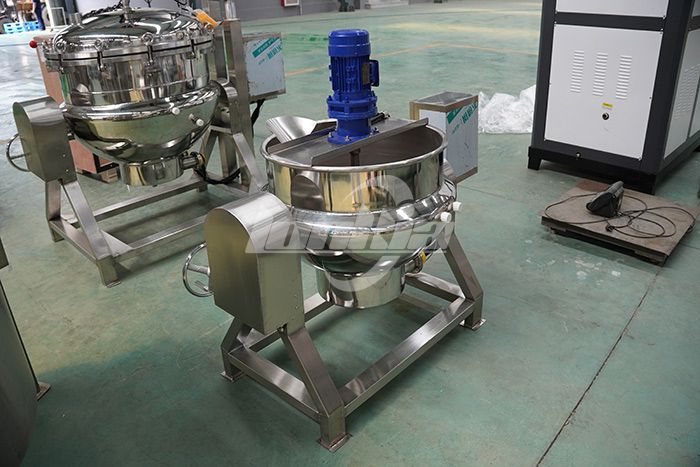
2. Key Factors That Affect Industrial Pressure Cooker Prices
a. Capacity / Size
The most obvious factor is how much volume the cooker can handle. Small-batch industrial cookers (e.g. a few dozen liters) are relatively affordable, while large-capacity models (hundreds to thousands of liters) cost significantly more — due to the extra steel, heavier sealing hardware, stronger hinges and supports. Larger capacity also demands sturdier heating systems and safety mechanisms.
b. Heating Method & Energy Source
Electric industrial pressure cookers: Equipped with built-in electrical heaters, they require wiring, thermostats, pressure control and often more precise temperature regulation. This increases complexity and cost.
Steam / Gas / Thermal-oil cookers: These may require external boilers or heat sources. Depending on the design, integration cost and installation requirements vary — influencing the final price.
Premium models may offer multi-mode heating (electric + steam + gas), which adds to cost but offers flexibility.
c. Material & Build Quality
Industrial cookers use food-grade stainless steel (often 304 or higher). The thicker the steel, the more durable and heavy-duty the cooker — but also more expensive. High-quality welds, polished interiors, robust sealing rings, safety valves and corrosion-resistant components all add up.
d. Automation & Control Features
Basic manual cookers are simpler and cheaper. More advanced units may include:
Pressure and temperature sensors, automatic pressure/vacuum release valves
Timers, digital control panels, programmable cooking cycles
Safety interlocks, safety locks, over-pressure protection
Electric heating with thermostatic control
These features improve convenience, safety and consistency — but raise the manufacturing cost.
e. Capacity Upgrades & Accessories
Optional features such as agitators (for sauces, soups), pressure-feeding inlets, discharge valves, tilting bases, built-in stirring, mixing devices, steam jackets, CIP (clean-in-place) systems — all increase the price. The more accessories and options, the higher the cost.
f. Certification, Testing & Compliance
Cookers intended for commercial food production often require compliance with safety and hygiene standards. Certifications, pressure tests, quality assurance, and documentation add cost — but are necessary for factory use, food safety, and compliance.
g. Brand, Origin, Warranty & After-Sales Service
Well-known brands or manufacturers with established track records may price higher, because of better reliability, established supply chains for spare parts, and after-sales support. Warranty coverage, spare-part availability, and technical support impact perceived value and price.
3. Typical Price Ranges for Different Models
Here’s a rough breakdown of expected price ranges depending on the configuration:
| Model Type | Capacity / Features | Estimated Price Range |
|---|---|---|
| Small-batch industrial cooker (manual or basic) | 50–200 L, manual controls, stainless steel | Low to mid-range |
| Mid-capacity cooker (electric or steam jacket, 300–800 L) | Built-in heating, pressure control, basic safety valves | Mid-range |
| Large-capacity cooker (1000 L+, steam/electric heating, safety & control systems) | Heavy-duty construction, high pressure rating, optional stirrer/mixer, discharge valve | Higher-end |
| Fully featured commercial cooker (agitating system, multiple heating modes, automation) | High throughput, remote controls, safety interlocks, CIP or tilting system | Premium |
💡 Rule of thumb: The larger the cooker, the more capacity and features you add — the price increases roughly in proportion to the volume of steel and complexity of control systems.
4. Which Model Should You Buy — Based on Your Use Case
Here’s a quick decision guide:
Small catering business or small-scale production → Choose a small-batch industrial cooker. Cost-effective, compact, and sufficient for moderate daily output.
Medium-sized restaurant chains, sauce or soup factories, central kitchens → A mid-capacity electric or steam-jacket cooker balances capacity, price, and automation.
Large-scale food manufacturing, canning plants, ready-meal factories → Invest in large-capacity or fully featured commercial cookers — higher initial cost but best ROI when throughput and consistency matter.
Specialty operations (sauces, jams, sauces, thick gravies) → Consider models with agitation, precise temperature control, and optional discharge/tilt valves for better processing control.
5. What to Consider Before Buying
Estimate your daily / weekly output and select capacity accordingly — avoid over-spec’ing (waste of capital) or under-spec’ing (bottleneck risk).
Choose the heating method (electric, steam, thermal-oil) based on available energy infrastructure and production needs.
Prioritize food-grade materials, hygiene compliance, safety valves, and pressure sealing quality for reliability and regulatory compliance.
Decide on automation level and control features — for high volume and continuous production, automation pays back over labor savings and consistency.
Check after-sales support, spare parts supply, and warranty — essential for long-term operation.
Consider future scalability — pick a model that can fit expanded production or additional accessories (mixers, discharge valves, multiple heating sources).
6. Conclusion
Industrial pressure cookers come in many configurations, and the price reflects the capacity, materials, heating method, automation, and safety features built into each model. Understanding these factors — capacity, construction quality, heating system, automation, and feature set — will help you choose the ideal model for your application without overspending.
Whether you're starting a small food business or running a large-scale production line, making the right selection ensures cost-efficient cooking, consistent product quality, safety compliance, and good return on investment.
👉 Take a moment to evaluate your production needs, energy supply, budget, and growth plans — then match those to the cooker type that fits best. A well-chosen industrial pressure cooker can significantly streamline your operations and boost productivity.