

When you plan to scale up food production — whether for sauces, soups, canned foods, large-volume meal prep, or ready-made dishes — one key decision is choosing the right pressure cooker for your facility. Large industrial pressure cookers and electric pressure cooker models both serve industrial/commercial kitchens, but each has distinct advantages and drawbacks. This article helps you compare them and decide which fits your production needs best.
What We Mean by “Large Industrial Pressure Cooker” and “Electric Pressure Cooker”
Large Industrial Pressure Cooker
Heavy-duty pressure vessel, often designed for steam, gas, or thermal-oil heating.
Large capacity — from several hundred liters to thousands of liters.
Built for batch cooking large volumes of food (sauces, soups, stews, canned goods, braised meat).
Typically uses external boilers or central steam systems for heating, or thermal-oil systems.
Electric Pressure Cooker (Industrial / Commercial Grade)
Integrated with electric heating elements.
Often more compact or mid-to-large capacity.
Easier installation — no need for external steam boilers or fuel sources.
Temperature and pressure controlled via electric controls, often offering precise heating.
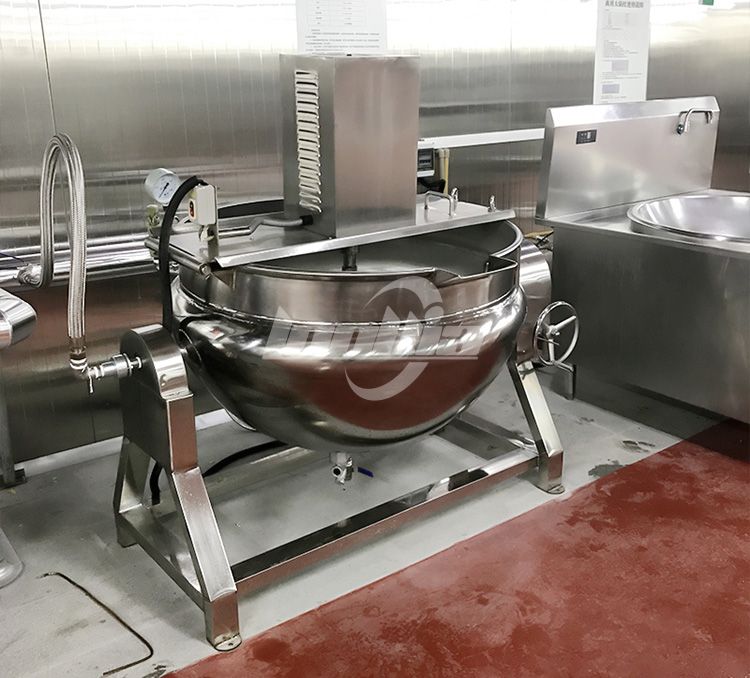
Key Comparison: Capacity, Efficiency, and Flexibility
✅ Capacity & Throughput
Large Industrial Pressure Cooker: Very high capacity, ideal for high-volume batch cooking. It shines when you need to process large quantities at once — e.g. mass sauce production, canned food lines, or centralized meal prep for many outlets.
Electric Pressure Cooker: Suitable for medium to moderately large volume production. For smaller factories, restaurants, or kitchens processing several hundred liters per batch, electric models provide enough capacity without excessive scale.
✅ Heating Method & Energy Supply Flexibility
Large Industrial Cooker: Can use steam, gas, or thermal oil — flexible for factories with existing boiler systems or fuel supply. More suitable where energy costs or fuel availability favor non-electric heating.
Electric Cooker: Simple installation requiring only power — advantageous for facilities lacking steam boiler infrastructure or where space/piping is limited. Electric heating offers precise temperature control, which benefits delicate recipes (e.g. sauces, creams, sensitive food products).
✅ Installation & Infrastructure Requirements
Large Industrial Cooker: Requires boiler, piping, or external heating system setup — higher upfront infrastructure investment. More complex installation and maintenance.
Electric Cooker: Easier to install, minimal auxiliary equipment, faster setup, less maintenance of external units.
✅ Operating Cost and Maintenance
Large Industrial Cooker: If your facility already has boiler or steam supply, operational cost per batch may be cheaper (especially for large volumes). But maintenance of boiler/steam system or gas/thermal means additional overhead.
Electric Cooker: Electric heating may have higher electricity costs, but maintenance is simpler, and no need to handle fuel, steam leaks, or boiler upkeep. For medium volume, may offer lower total maintenance burden.
✅ Precision, Control and Usability
Electric Cooker: Often has precise thermostatic control, digital timers, easy pressure regulation — ideal for dishes or products requiring stable cooking parameters, repeatability, and consistent quality.
Industrial Cooker: While powerful, may need skilled operators to manage steam pressure, heat-up times, and cooling — suitable for large-volume, less delicate cooking tasks.
Which Model Fits Which Scenario?
| Scenario / Need | Better Option |
|---|---|
| Large-scale sauce, soup, canned food production; hundreds to thousands of liters per batch | Large Industrial Pressure Cooker |
| Medium-sized food factory, restaurant chain central kitchen, flexible batch sizes | Electric Pressure Cooker (commercial grade) |
| Facility with existing steam boiler/thermal-oil system, high energy demand, large throughput | Large Industrial Cooker |
| Small-to-medium production, limited space, simpler infrastructure, precise temperature control | Electric Cooker |
| Need for consistent quality, easy operation, minimal maintenance | Electric Cooker |
| High-volume throughput with lower per-unit energy cost and if infrastructure supports steam/gas | Industrial Cooker |
Other Factors to Consider Before Choosing
Available Utilities and Infrastructure: Whether you have steam boiler, gas line, thermal-oil system, or only electricity.
Batch Size & Frequency: How much you need to cook per batch — daily output demands.
Type of Food Product: Sensitive sauces, creams, or temperature-sensitive recipes may benefit from electric models. Bulk soups, stews, or canned meals may lean toward industrial cookers.
Labor & Skill Level: Electric cookers usually easier to operate, less dependent on manual adjustments. Industrial cookers may need more experienced staff.
Maintenance & Safety: Boilers or steam systems require maintenance; electric systems have simpler maintenance but may have higher energy costs.
Cost of Ownership (Total Cost Over Time): Not only purchase price — include energy consumption, maintenance, repairs, downtime, and workforce.
Conclusion: No One-Size-Fits-All — Choose Based on Your Needs
There is no absolute “best” between a large industrial pressure cooker and an electric model. The right choice depends on your production volume, infrastructure, types of food processed, and long-term operational plans.
For large-scale food manufacturing, canned goods, mass cooking, and where infrastructure allows — a large industrial pressure cooker often brings better throughput and lower per-unit cost.
For mid-scale production, flexibility, simpler setup, and precise cooking requirements — a commercial electric pressure cooker offers a clean, efficient, and easy-to-operate solution.
👉 The smart approach is to evaluate your production volume, energy supply, budget, and staffing. Then choose the cooker type that matches your real-world needs — sometimes even a combination of both (electric + industrial) may offer maximum flexibility and efficiency.