

In the food processing industry, selecting a jacketed kettle with the appropriate capacity directly impacts production efficiency, product quality, and operational stability. When purchasing jacketed kettles, many customers often focus solely on the price of the equipment while overlooking the need to match the capacity to their actual production requirements. A capacity that is too small can hinder continuous production, while a capacity that is too large may result in reduced heating efficiency and energy waste. Therefore, selecting a jacketed kettle that suits the specific production process has become a critical aspect of equipment configuration for food processing plants.
Currently, industrial jacketed kettles are widely used in the processing of chili sauce, hot pot bases, jams, syrups, fillings, concentrated soups, and seasonings. Depending on product characteristics, these units are typically available in a range of capacities from 50L to 2000L and support various heating methods, including steam, electric, and gas.
Why does Capacity Affect Food Processing Efficiency?
Jacketed kettles feature a double-walled jacket structure that ensures uniform heat transfer through the interlayer, resulting in more stable heating of the material. Compared to standard kettles, jacketed kettles effectively reduce the risk of scorching caused by localized high temperatures, making them particularly suitable for processing high-viscosity foods.
If the equipment capacity is selected improperly, the following issues may arise:
- Insufficient batch size per load, increasing the number of re-heating cycles
- Longer heating times, affecting overall production capacity
- Insufficient mixing space, leading to uneven heating of the material
- Reduced discharge efficiency, impacting subsequent packaging processes
Therefore, properly matching production output with equipment capacity can help factories improve production stability and reduce the burden of manual operations.
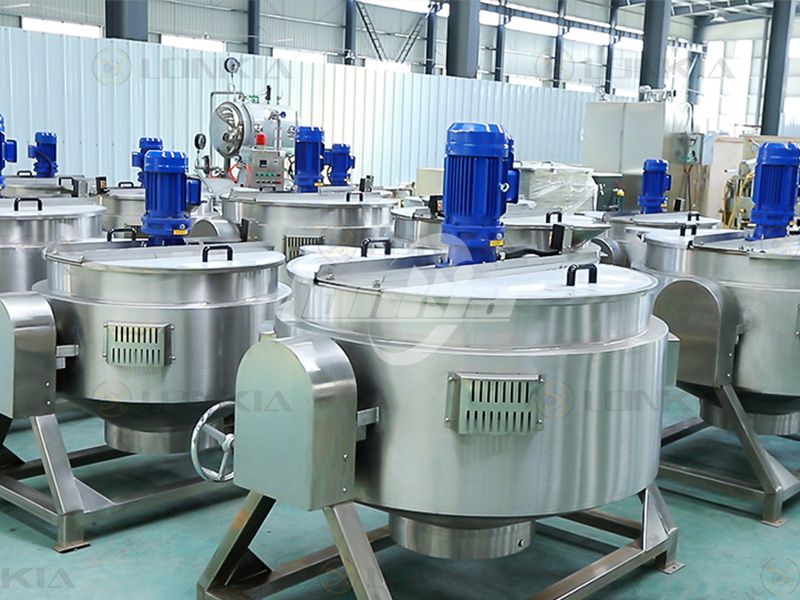
Which Jacketed Kettle Capacities are Suitable for Different Foods?
Different foods have varying requirements for jacketed kettles during processing.
Sauces and High-Viscosity Products
Products such as chili sauce, beef sauce, and red bean paste have high viscosity and tend to settle at the bottom during heating. These products are typically better suited for jacketed kettles equipped with a scraping agitator system. Continuous stirring reduces scorching and improves material uniformity.
For continuous production facilities, medium-to-high-capacity equipment can effectively increase batch processing volume and reduce time spent on frequent batch loading.
Soups and Liquid Foods
For highly fluid products such as thick soups, brine, and syrups, appropriate specifications can be selected based on actual daily output. Liquid products have relatively lower agitation requirements but demand higher stability in temperature control; therefore, an automatic temperature control system is particularly important.
Hot Pot Bases and Granular Foods
Products such as hot pot bases and fruit-based sauces contain a high proportion of granular materials during processing. These are better suited for planetary or scraper-type agitation systems to prevent material buildup and improve overall heat distribution.
How to Calculate the Right Equipment Capacity for Your Needs?
Many customers are unsure how to determine the appropriate capacity before purchasing. In fact, this can be assessed based on the following factors.
Calculate Based on Daily Output
First, confirm the total daily product volume to be processed, then convert this figure by considering the processing time per batch and the number of batches required. For example, if 1,000 kg of product needs to be processed daily, and a single batch can process 200 kg, running five batches per day will meet the demand.
Allow for Adequate Mixing Space
For high-viscosity foods, equipment typically does not operate at full capacity; a certain amount of mixing space must be reserved to ensure effective mixing and uniform heating. Therefore, the actual effective capacity is usually lower than the equipment's rated capacity.
Select Based on Heating Method
Steam jacketed kettles provide stable temperature rise and are suitable for factories with existing boiler systems; electric heating equipment is easy to install; gas heating offers rapid temperature rise. Different heating methods affect the equipment's overall structure and production efficiency.
Automation is Becoming an Industry Trend
Modern food factories are placing increasingly higher demands on automation, and more and more jacketed kettles are being equipped with:
- Automatic wall-scraping stirring systems
- Hydraulic tilting for discharge
- PLC intelligent control systems
- Variable frequency speed control
- Automatic temperature display and control
These features effectively reduce manual labor, improve product consistency, and minimize processing errors caused by human factors.
Conclusion
For food processing plants, selecting a jacketed kettle with the appropriate capacity is not merely a matter of choosing equipment specifications; it is a crucial step in optimizing production processes. Proper capacity configuration, stable heating methods, and stirring systems suited to product characteristics can help enterprises improve processing efficiency, reduce production issues, and achieve more consistent product quality.