

In food processing, selecting the right steam jacketed kettle directly impacts production efficiency, product quality, and long-term operating costs. For procurement professionals, the key factor is not the price, but whether the equipment meets actual production needs. This article will help you identify the core considerations for purchasing.
Understand the Heating Method and Operating Principle
Steam jacketed kettles utilize an indirect heating structure: steam circulates within the jacket, evenly transferring heat to the contents in the inner pot, thereby preventing localized overheating and scorching.
The advantages of this structure include:
- Even heating and consistent product quality
- Suitable for high-viscosity materials such as sauces and syrups
- Easier temperature control
👉 Selection Tip: If your product is prone to burning or is temperature-sensitive, a steam-jacketed kettle is the better choice.
Focus on Equipment Structural Design
A high-quality steam jacketed kettle typically includes:
- Inner pot (food-contact surface)
- Steam jacket (heating core)
- Agitation system (optional)
- Discharge or discharge structure
A well-designed structure enhances efficiency. For example:
- Hemispherical kettle body → Increases heat transfer surface area
- Tilting design → Reduces residue and improves discharge efficiency
- Bottom-scraping agitator → Prevents sticking
Equipment like Lonkia's features a one-piece molded structure and smooth inner walls, which help minimize material adhesion and improve cleaning efficiency—a critical factor in continuous production.
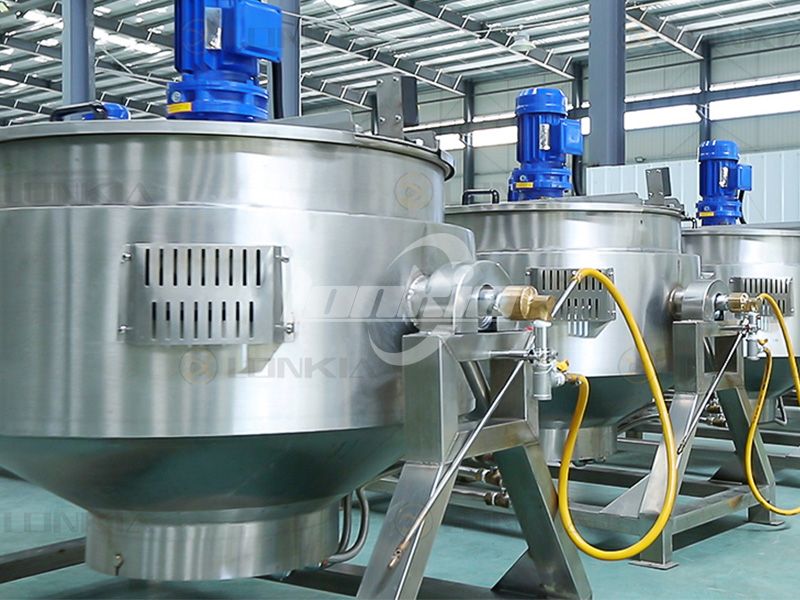
Material Selection Determines Equipment Lifespan and Food Safety
Currently, mainstream equipment uses food-grade stainless steel (such as 304/316), which offers the following advantages:
- Corrosion resistance (suitable for acidic materials)
- High-temperature resistance (suitable for long-term steam environments)
- Easy to clean, compliant with food hygiene standards
👉 Purchasing Recommendations:
Do not overlook material thickness and grade, as these directly affect the steamed jacketed kettle's service life and maintenance costs.
The Need for a Stirring System
Many customers overlook this aspect during selection, yet it is actually crucial.
Steam-jacketed kettles with stirring are suitable for:
- High-viscosity products such as sauces, jams, and syrups
- Materials prone to sedimentation or clumping
Advantages:
- More uniform heating
- Prevents localized scorching
- Improves product consistency
If your product falls into the above categories, we recommend prioritizing models with a stirring mechanism.
The Importance of Temperature Control and Operating Systems
Temperature control directly impacts product texture and stability. High-quality steam jacketed kettle typically features:
- Precise temperature control systems
- Automatic or semi-automatic control panels
- Steam pressure adjustment functions
These features ensure stable temperatures during processing, thereby preventing batch-to-batch variations and improving product standardization.
Discharge and Cleaning Design Should Not Be Overlooked
In actual production, discharge efficiency and ease of cleaning often determine how user-friendly the equipment is.
- Key considerations include:
- Whether it supports tilt-out discharge
- Whether it has a bottom valve
Whether the inner walls are smooth with no hard-to-reach corners
A well-designed unit can significantly reduce manual labor time while lowering cleaning costs.
Selecting Configurations Based on Product Applications
Steam jacketed kettles are widely used in:
- Sauce processing
- Soups and porridges
- Dairy products
- Candy and jam
Their core advantages are "versatility + stable heating," making them suitable for various food processing scenarios.
👉 Purchasing Advice:
Avoid blindly choosing a generic model; instead, customize the configuration based on the specific product viscosity, output, and process requirements.
Summary
Choosing the right steam jacketed kettle is fundamentally about matching your production needs, not simply comparing prices.
Key Evaluation Criteria:
- Does it heat evenly? (Determines product quality)
- Is it easy to operate? (Impacts labor costs)
- Is it durable? (Determines long-term investment)
- Does it align with your production process?
For companies seeking stable production and long-term operation, choosing a steam jacket kettle like Lonkia—which is optimized in structure, materials, and details—can more effectively reduce production risks and improve overall efficiency.