

In industries such as food processing and logistics, inadequate pallet cleaning often leads to issues like residue, contamination, and inefficiency. Compared to traditional manual cleaning, plastic pallet washers achieve consistent and efficient cleaning results through standardized processes, making them the choice of an increasing number of companies.
This article will break down the equipment's complete workflow in detail to help you truly understand how it solves cleaning challenges.
Operating Logic of the Pallet Washer: Continuous Automatic Cleaning
Plastic pallet washers typically feature a conveyor-based design, where pallets automatically enter the cleaning channel via a chain or mesh belt, sequentially completing multiple cleaning stages without any manual intervention. The entire process is controlled by a PLC system, ensuring stable cycle times and consistent cleaning results.
For customers, the core value of this continuous operation lies in:
- Avoiding inconsistencies caused by manual handling
- Improving overall production line efficiency
- Achieving standardized batch cleaning
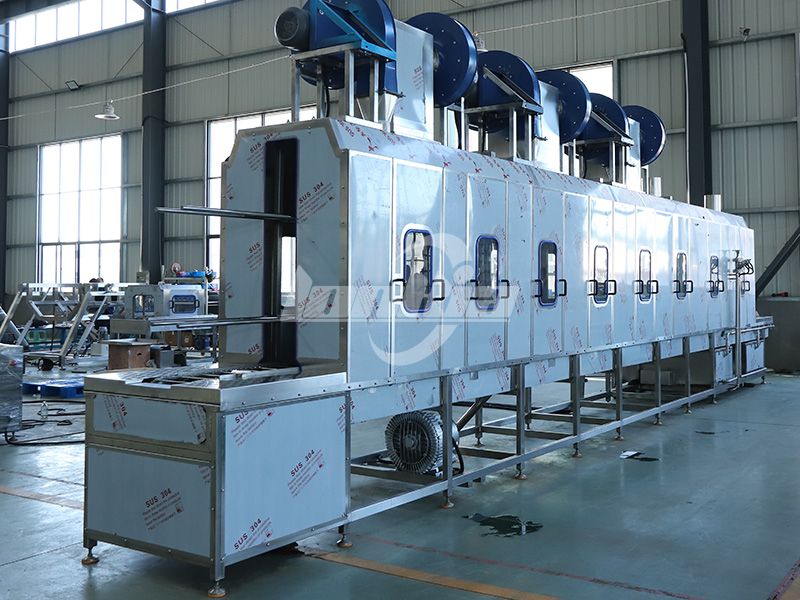
Workflow of the Pallet Washer Machine
1. Automatic Feeding: Reducing Manual Labor and Improving Efficiency
In actual production, manually handling pallets is not only inefficient but also prone to causing secondary contamination. The pallet cleaning machine uses a conveyor system for automatic feeding, continuously feeding pallets into the cleaning area.
The core value of this process lies in:
- Reducing manual involvement
- Maintaining a stable production rhythm
- Enabling continuous operation
The pallet washer machine is typically controlled by a PLC, ensuring precise and consistent positioning of each pallet as it enters, thereby laying the foundation for subsequent cleaning.
2. Pre-wash
After entering the equipment, the pallets first pass through the pre-wash zone. This stage uses high-pressure spraying to quickly remove large-particle contaminants such as surface dirt and debris.
Advantages:
- Reduces the burden on subsequent cleaning stages
- Prevents recirculation of contaminants into the water system
- Improves overall cleaning efficiency
This step is the critical foundation for ensuring effective deep cleaning in subsequent stages.
3. Main Wash
This is the most critical stage of the entire plastic pallet washer workflow. The equipment uses multi-angle high-pressure spraying, combined with hot water or detergent, to thoroughly rinse the pallets.
Key features include:
- High-pressure nozzles reach every corner of the pallet
- Hot water effectively breaks down grease
- Multi-angle spraying improves cleaning uniformity
Real-world problems addressed:
- Stubborn grease that is difficult to clean
- Residue in grooves and holes
- Inconsistent manual cleaning
Taking Lonkia equipment as an example, its spray system is optimally designed to achieve more thorough coverage, ensuring stable and reliable pallet cleaning results.
4. Rinsing
After the main wash, the trays enter the rinsing zone, where clean water is used to thoroughly rinse away any residual detergent.
Why is this step important?
- To prevent detergent residue
- To avoid secondary contamination
- To ensure the trays are ready for immediate use
For food-related industries, this step directly impacts safety and quality control.
5. Air Drying or Hot Air Drying
Finally, the pallets enter the drying zone, where surface moisture is rapidly removed via air knives or a hot air system.
This stage helps customers address:
- The issue of long natural drying times
- The risk of secondary contamination from wet pallets
- Waiting time on the production line
The drying system significantly reduces waiting time, allowing pallets to return to the production process immediately after cleaning and improving overall efficiency.
Why Is This Process More Efficient?
Compared to traditional cleaning methods, the plastic pallet washer offers the following process advantages:
- Standardized process: Consistent cleaning results for every pallet
- Continuous operation: Suitable for high-volume production needs
- Automated control: Reduces human error
- Multi-stage cleaning: Ensures more thorough cleaning
Studies show that automated pallet washing equipment can process large quantities of pallets in a short time while ensuring consistent cleaning quality.
Summary
When selecting pallet cleaning machine, many customers are most concerned about:
- Whether it can clean thoroughly
- Whether it can deliver consistent results
- Whether it can adapt to continuous production
The plastic pallet washer, with its complete process of "automatic feeding + pre-wash + main wash + rinse + drying," is a solution specifically designed to address these issues.
If you are looking for a stable, efficient pallet cleaning solution, equipment like Lonkia’s can be customized based on your actual production capacity and pallet types to truly meet your production needs.