

In modern food processing, logistics, and packaging industries, cleaning baskets and crates is a necessary but often time-consuming task. Traditional manual washing consumes large volumes of water, requires intensive labor, and often fails to meet hygiene standards consistently.
That’s where automated industrial basket washers come in. Designed with efficiency, consistency, and sustainability in mind, these systems can dramatically reduce both labor costs and water consumption while maintaining excellent cleaning performance.
1. The Challenge of Manual Basket Cleaning
For many facilities, baskets and crates are washed manually using hoses or simple washing tanks. While this method seems inexpensive at first, it leads to several operational challenges:
High labor demand: Workers must handle, scrub, and rinse each basket manually.
Inconsistent cleaning results: Human error and fatigue lead to uneven cleanliness.
Excessive water usage: Continuous rinsing wastes thousands of liters of water daily.
Low productivity: The process is slow and difficult to scale with increasing production volumes.
As production lines expand, these drawbacks become bottlenecks that limit overall efficiency and raise operational costs.
2. The Role of Automated Industrial Basket Washers
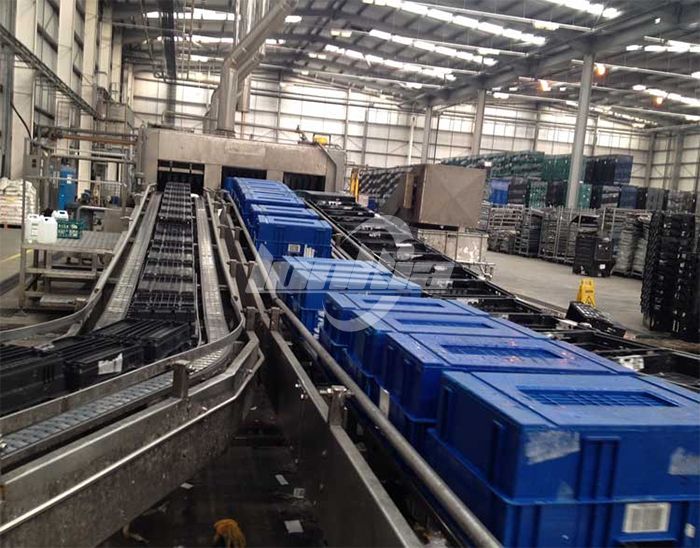
An automated industrial basket washer replaces manual cleaning with a controlled, high-efficiency process. Using high-pressure nozzles, filtration systems, and optional heating or detergent dosing, these machines ensure each basket is cleaned thoroughly and quickly.
Depending on the design, baskets can be washed in continuous tunnel systems or rotating drum configurations. The automation level reduces manual handling to nearly zero — workers only load baskets onto the conveyor, and the system does the rest.
3. Labor Savings Through Automation
Automation is one of the biggest advantages of industrial washers.
Reduced manual work: One operator can manage the machine instead of several workers scrubbing by hand.
Consistent cleaning: Automated cycles follow preset programs that guarantee repeatable results.
Improved productivity: Continuous conveyor-fed washing allows hundreds of baskets per hour to be processed.
Enhanced workplace safety: Minimizes exposure to hot water, detergents, and repetitive movements.
For large-scale operations such as food plants or dairy factories, labor savings alone can pay back the investment in a short period.
4. Water Recycling and Filtration Systems
Modern basket washers are designed with water conservation as a key priority.
Most machines include multi-stage water circulation and filtration systems, which reuse rinse water in earlier wash cycles. Fine filters and sediment traps remove residues and food particles, ensuring effective cleaning while minimizing waste.
Compared with manual washing, automated systems can reduce water consumption by up to 70%, depending on the configuration.
Some advanced models also integrate automatic water level control, temperature monitoring, and detergent dosing for optimal efficiency.
5. Hygienic and Energy-Efficient Design
In industries like food processing, hygiene cannot be compromised. Automated basket washers maintain consistent cleaning and disinfection through:
High-temperature washing (60–85°C) for removing fats and bacteria
Optional sanitizing rinse or hot-air drying
304 or 316 stainless steel construction to prevent corrosion and contamination
Clean-in-Place (CIP) systems for easy internal cleaning
Energy efficiency is also improved through heat recovery systems and insulated tanks, which reduce steam or electricity consumption.
6. Case Example: Productivity and Cost Comparison
| Cleaning Method | Labor Required | Water Usage | Output Capacity | Consistency |
|---|---|---|---|---|
| Manual Washing | 3–4 workers | High (uncontrolled) | 60–100 baskets/hour | Variable |
| Semi-Automatic | 1–2 workers | Moderate | 200–400 baskets/hour | Improved |
| Fully Automatic | 1 operator | Low (recycled) | 800–2000 baskets/hour | Consistent |
This comparison shows how automated systems significantly reduce both human effort and water consumption while increasing throughput — a critical factor for growing facilities.
7. Long-Term Operational Benefits
Investing in an automated basket washer is not just about convenience — it’s about long-term cost control and process optimization.
Key benefits include:
Lower labor expenses
Reduced water and detergent costs
Higher hygiene standards
Extended equipment lifespan
Better compliance with food safety regulations
Cleaner and safer work environment
When viewed over a multi-year period, the return on investment (ROI) from automation is substantial.
Conclusion
Switching to an automated industrial basket washer is one of the smartest decisions a production facility can make to boost efficiency and sustainability. By minimizing manual labor, recycling water, and ensuring consistent hygiene, these systems transform what was once a labor-intensive task into a streamlined, eco-friendly operation.
Whether you’re in food processing, dairy, or logistics, adopting automation today can lead to cleaner products, lower costs, and a more sustainable tomorrow.